Cambridge International · IGCSE · English Literature
I'm the King of the Castle
Susan Hill's 'I'm the King of the Castle' is a chilling exploration of psychological bullying, adult neglect, and the destruction of childhood innocence. This guide unpacks the novel's Gothic atmosphere and complex power dynamics to help you craft perceptive, top-band IGCSE responses.
- 8 min read
- 2 worked examples
- 4 practice questions
- 8 key terms
Study Notes
Overview
Published in 1970, Susan Hill's I'm the King of the Castle is a masterclass in psychological tension and atmospheric writing. The novel explores the devastating consequences of a child-on-child bullying campaign, enabled by the profound emotional neglect of the adults meant to protect them. For Cambridge IGCSE Literature candidates, this text offers rich opportunities to analyse complex power dynamics, sophisticated Gothic symbolism, and Hill's deliberate subversion of childhood innocence. Examiners consistently reward responses that move beyond plot summary to offer perceptive analysis of Hill's methods—particularly her use of setting to mirror psychological states, and her nuanced portrayal of the adults not as simple villains, but as tragically self-absorbed figures whose ordinary failures have catastrophic results.
Plot/Content Overview
Arrival and Immediate Hostility: The novel begins with ten-year-old Edmund Hooper inheriting the large, decaying Victorian mansion, Warings, from his grandfather. When his widowed father, Joseph, invites Helena Kingshaw and her son Charles to live with them, Hooper immediately claims dominance, leaving Kingshaw a note: "I didn't want you to come here."
The Campaign of Terror: Hooper systematically isolates and terrifies Kingshaw. He locks him in the Red Room (filled with his grandfather's taxidermy), exploiting Kingshaw's fears. Kingshaw's attempts to escape to Hang Wood only result in him becoming lost, though he briefly gains the upper hand when Hooper shows fear. However, upon their return, Hooper manipulates the situation, and the adults blame Kingshaw.
Escalation and Isolation: The bullying intensifies. Kingshaw is attacked by a crow in a cornfield—a visceral symbol of his arbitrary victimisation. The adults, entirely consumed by their own budding romance, remain oblivious to Kingshaw's distress. Mrs Kingshaw continually dismisses her son's fears, urging him to conform.
Brief Hope and Final Despair: Kingshaw finds a moment of respite through a friendship with a local boy, Anthony Fielding. However, Hooper deliberately infiltrates and destroys this sanctuary. Realising that his mother is going to marry Mr Hooper and that he will be permanently trapped with his tormentor, Kingshaw walks into a stream and drowns himself. The novel ends with Hooper feeling a chilling sense of triumph.
Themes
Theme 1: Power, Cruelty and Bullying
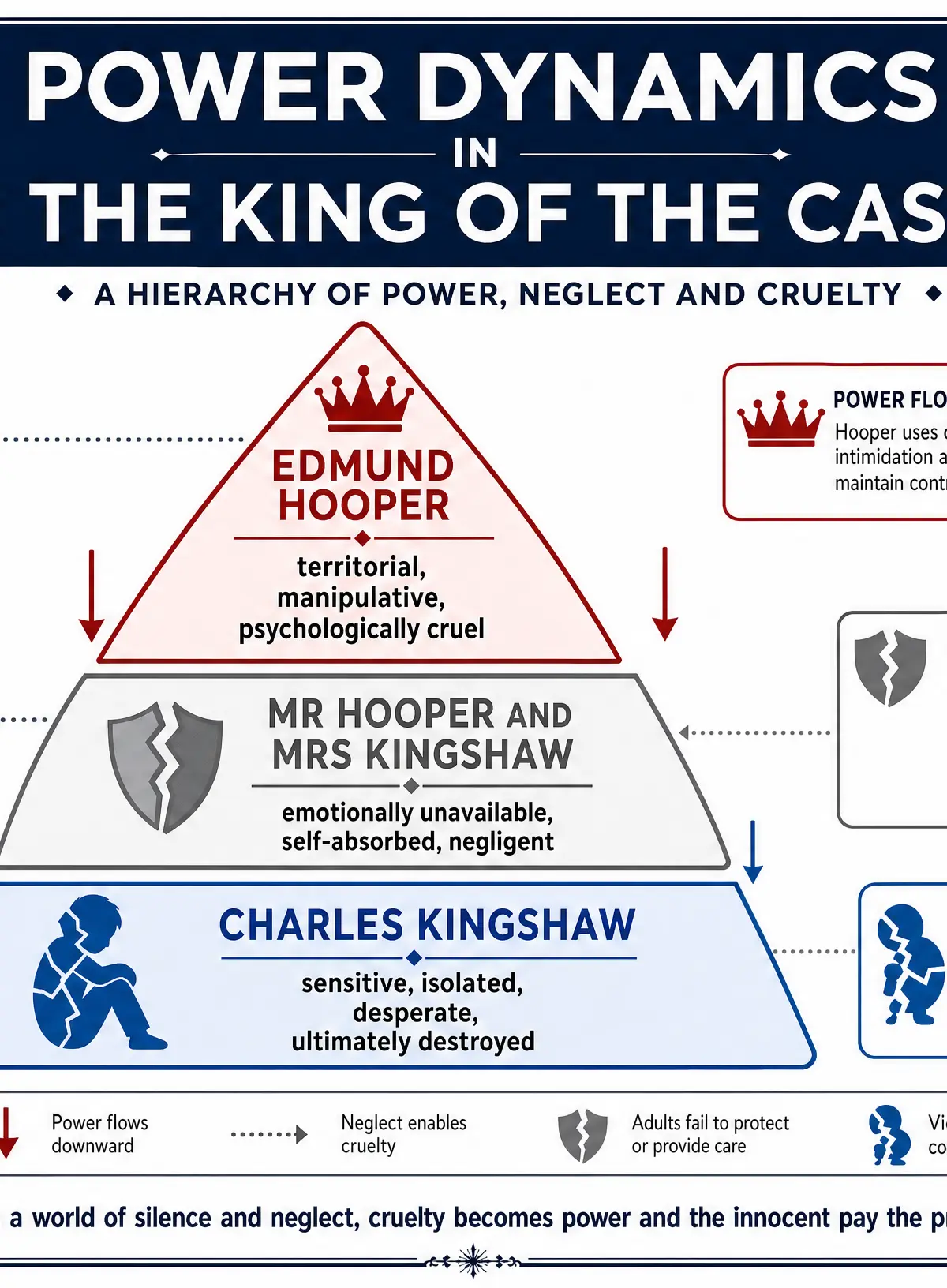
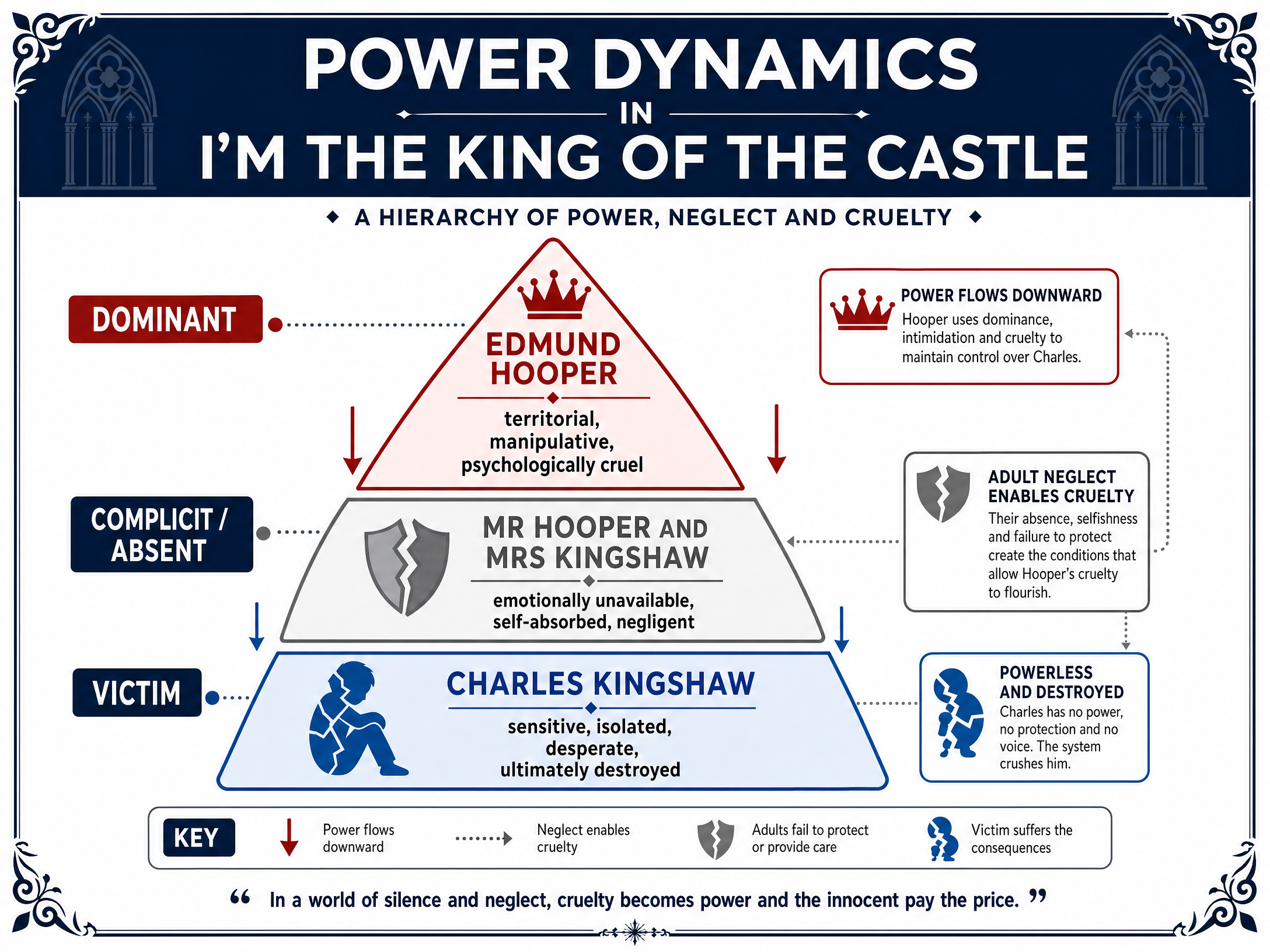
Hill presents bullying not merely as physical violence, but as a sophisticated psychological war. Hooper's cruelty is calculated, territorial, and relentless. He identifies Kingshaw's vulnerabilities and exploits them to establish total dominance. However, top-band answers must acknowledge that Hooper's behaviour stems from his own emotional deprivation; his cruelty is a displacement of the powerlessness he feels regarding his cold, distant father.
Key Quotes:
- "I didn't want you to come here." (Chapter 1) - Establishes Hooper's territorial aggression and premeditated cruelty immediately.
- "He had discovered that he could make Kingshaw afraid." (Chapter 4) - Highlights the psychological nature of the bullying; fear is Hooper's primary weapon.
Theme 2: Adult Failure and Neglect
The novel offers a devastating critique of adult self-absorption. Mr Hooper and Mrs Kingshaw are not monsters, but their ordinary selfishness creates the vacuum in which Hooper's cruelty flourishes. Mr Hooper is emotionally unavailable, while Mrs Kingshaw is ambitious and willfully blind to her son's suffering, prioritising her financial security over his welfare.
Key Quotes:
- "She did not want to know, she did not want to hear." (Chapter 8) - Demonstrates Mrs Kingshaw's willful ignorance; she actively chooses not to protect her son.
- "He was a man who did not know what to do with a child." (Chapter 2) - Summarises Mr Hooper's profound emotional inadequacy and failure as a father.
Theme 3: The Gothic Setting and Atmosphere
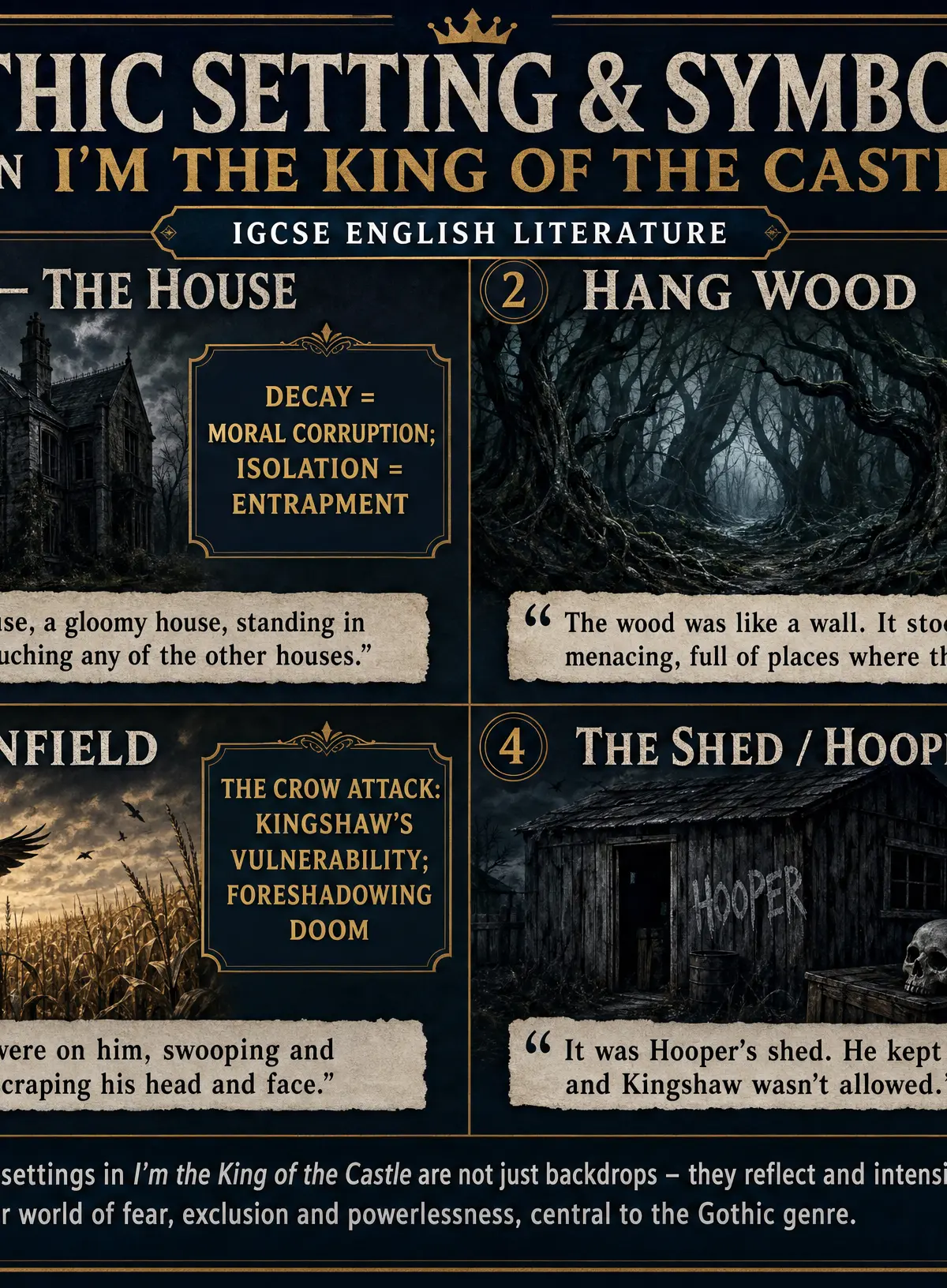
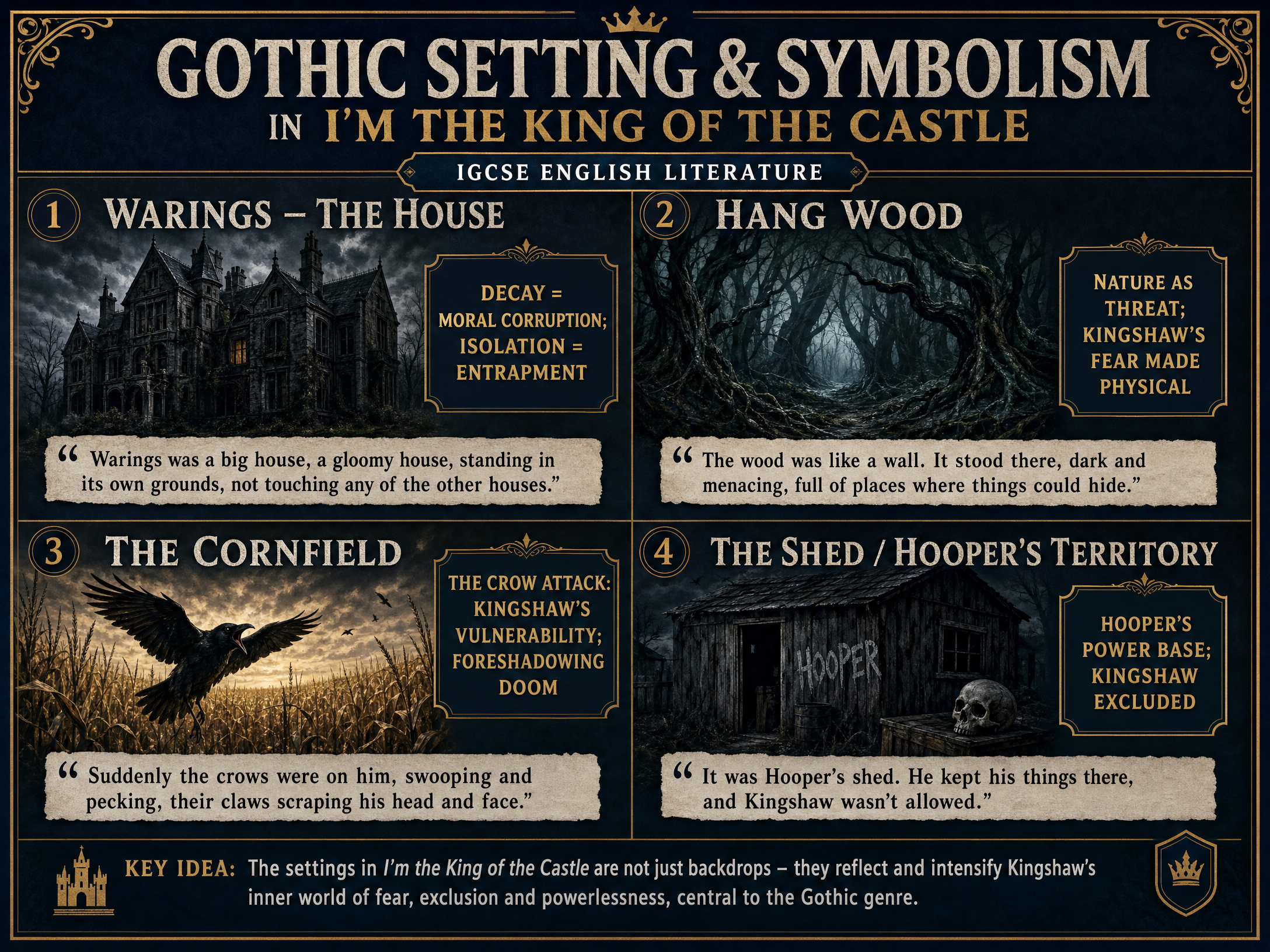
Hill utilises classic Gothic tropes—decaying mansions, dark woods, and omens of doom—to externalise Kingshaw's psychological entrapment. Warings is a space of death (symbolised by the Red Room), while nature (Hang Wood, the cornfield) offers no solace, instead acting as a hostile force that mirrors Hooper's cruelty.
Key Quotes:
- "Warings was a big house, a gloomy house, standing in its own grounds, not touching any of the other houses." (Chapter 1) - The physical isolation of the house mirrors the emotional isolation of its inhabitants.
- "The wood was like a wall. It stood there, dark and menacing..." (Chapter 5) - Nature is presented as an oppressive, hostile force, amplifying Kingshaw's fear.
Theme 4: The Corruption of Childhood Innocence
Hill subverts the Romantic ideal of childhood as a time of freedom and joy. For Kingshaw, childhood is a state of absolute powerlessness. He has no agency, no voice, and no protection. The novel forces the reader to confront the reality that childhood can be a space of profound suffering.
Key Quotes:
- "He felt entirely alone, entirely without hope." (Chapter 11) - Captures the absolute despair of Kingshaw's situation; a stark contrast to traditional views of childhood.
Character Analysis
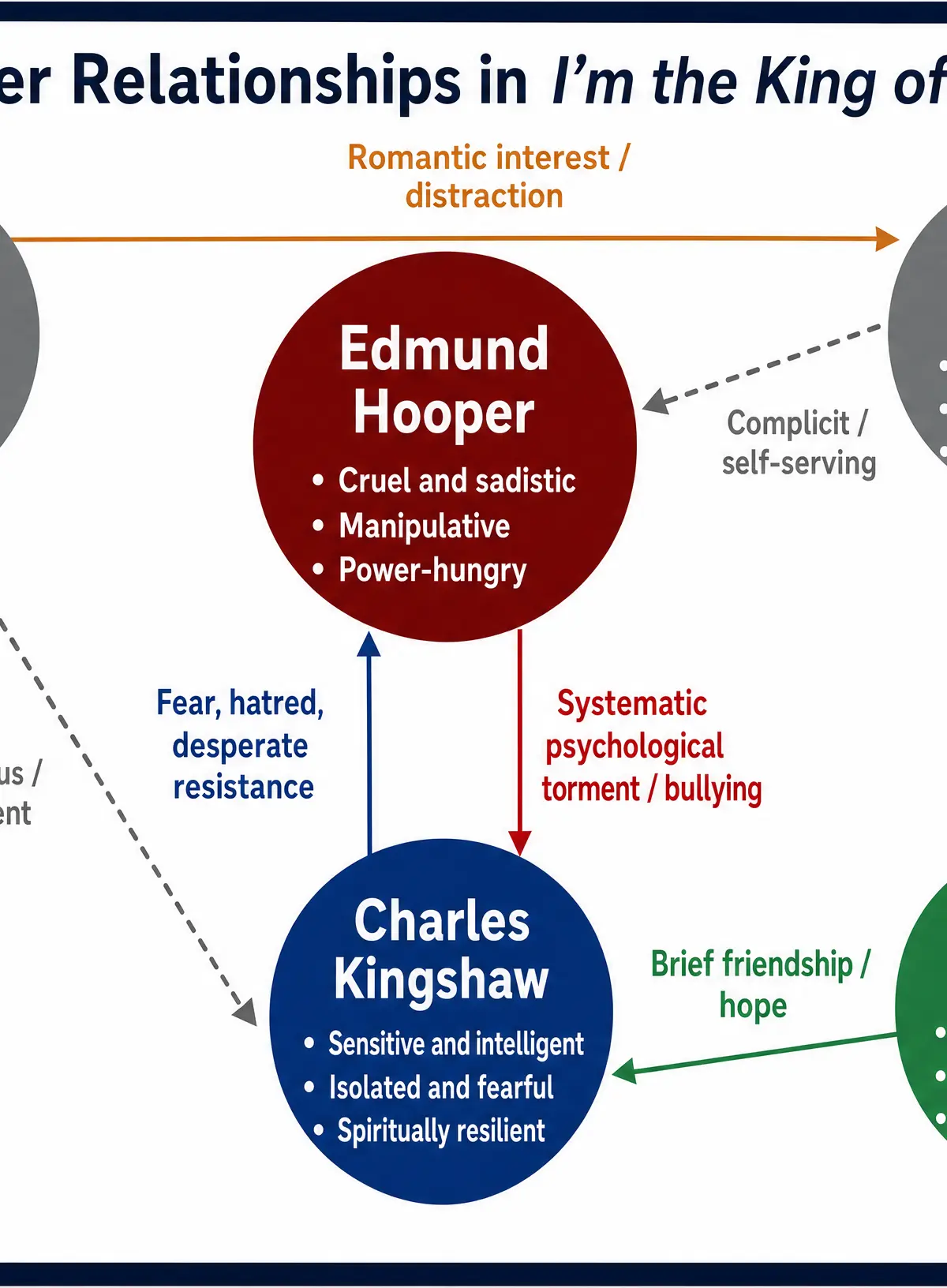
Edmund Hooper
Role: The antagonist; the architect of Kingshaw's psychological torment.
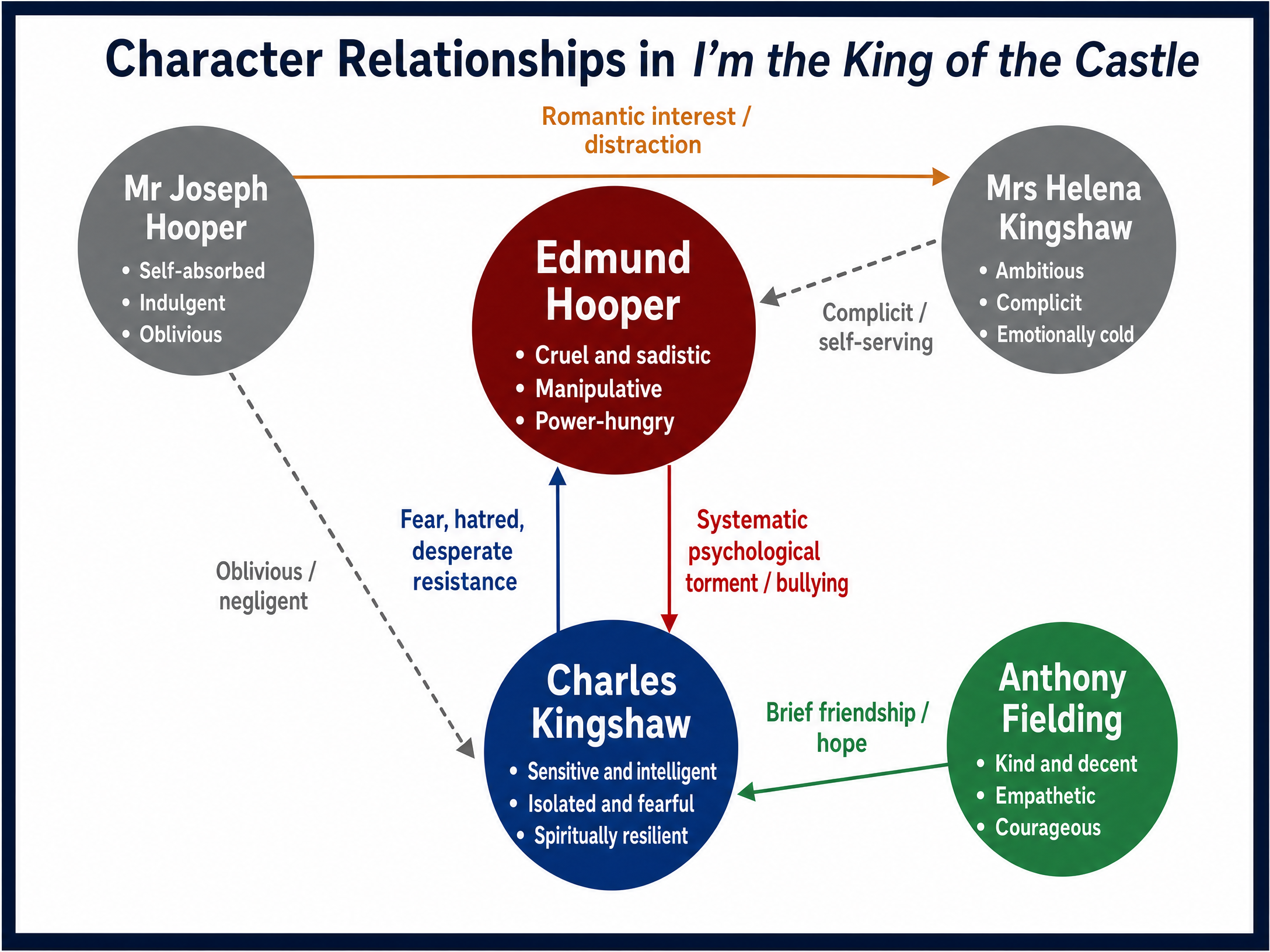
Key Traits: Territorial, manipulative, sadistic, yet emotionally neglected.
Character Arc: Hooper begins by establishing dominance and systematically dismantles Kingshaw's psychological defences. His arc does not lead to redemption; it ends in chilling triumph.
Essential Quotes:
- "Hooper felt a sudden, thrilling sense of power."
- "He wanted Kingshaw to be there, so that he could hate him."
Charles Kingshaw
Role: The victim; the tragic protagonist whose innocence is destroyed.
Key Traits: Sensitive, imaginative, isolated, deeply fearful but occasionally resilient.
Character Arc: Kingshaw moves from initial apprehension to desperate resistance, brief hope (in the woods and with Fielding), and finally to absolute despair and suicide when he realises escape is impossible.
Essential Quotes:
- "He was a boy who was used to being afraid."
- "There was nowhere to go. Nothing to do."
The Adults (Mr Hooper & Mrs Kingshaw)
Role: The enablers; their neglect provides the environment for the tragedy.
Key Traits: Self-absorbed, oblivious, emotionally cold, ambitious (Mrs Kingshaw).
Character Arc: Neither adult experiences growth or anagnorisis (recognition). They remain willfully blind to the end, cementing the novel's tragic outcome.
Essential Quotes:
- "They were entirely wrapped up in themselves."
- "'You must try to be more like Edmund,' she said."
Writer's Methods
- Narrative Perspective and Free Indirect Discourse: Hill frequently slips into Kingshaw's consciousness, allowing the reader to experience his visceral terror and isolation firsthand, building immense empathy and tension.
- Pathetic Fallacy and Setting: The oppressive weather (storms, oppressive heat) and hostile environments (the decaying Warings, the threatening Hang Wood) constantly mirror the psychological warfare and foreshadow the tragic end.
- Symbolism: The taxidermy in the Red Room symbolises the Hoopers' desire to control and possess; the crow represents arbitrary, inescapable cruelty; the moth beating against the glass represents Kingshaw's futile struggle for freedom.
- Foreshadowing: Hill meticulously plants clues pointing to Kingshaw's inevitable doom, creating a pervasive atmosphere of fatalism.
Context
While I'm the King of the Castle is not a historical novel, it reflects 1970s anxieties regarding child psychology and welfare. During this period, society was becoming increasingly aware of the psychological complexities of childhood and the long-term impacts of emotional neglect and bullying. Hill's novel challenges the post-war assumption that children are safe within the private domestic sphere, exposing the home as a potential site of profound psychological abuse. Examiners reward candidates who weave this understanding of changing attitudes towards childhood into their analysis of the adult characters' failures.
Podcast Revision Episode
Listen to this comprehensive 11-minute revision podcast covering the plot, themes, character analysis, and essential exam techniques to help you secure top marks.

Visual Resources
3 diagrams and illustrations
Interactive Diagrams
1 interactive diagram to visualise key concepts
Conceptual Flow Outline
The Escalation of Kingshaw's Entrapment
Worked Examples
2 worked examples — open one to explore the question and available guidance.
Practice Questions
Test your understanding — click to reveal model answers
How does Hill use settings to create an atmosphere of fear and isolation in the novel? (30 marks + 4 AO4)
Hint: Don't just describe the settings. Explain *how* they reflect Kingshaw's internal state (pathetic fallacy) and *how* Hooper uses them as weapons.
Explore how Hill presents the relationship between Hooper and Kingshaw. (30 marks + 4 AO4)
Hint: Focus on the *psychological* nature of their conflict. Why does Hooper need to dominate? Why can't Kingshaw fight back?
In what ways is the ending of the novel effective? (30 marks + 4 AO4)
Hint: Consider why Hill refuses to give the reader a happy ending. What is the moral impact of Hooper's triumph?
Starting with this extract (the crow attack in the cornfield), explore how Hill uses nature and animals to create tension. (30 marks + 4 AO4)
Hint: Nature is not a safe space in this novel. Look at how animals (the crow, the taxidermy, the moth) symbolise threat or entrapment.